
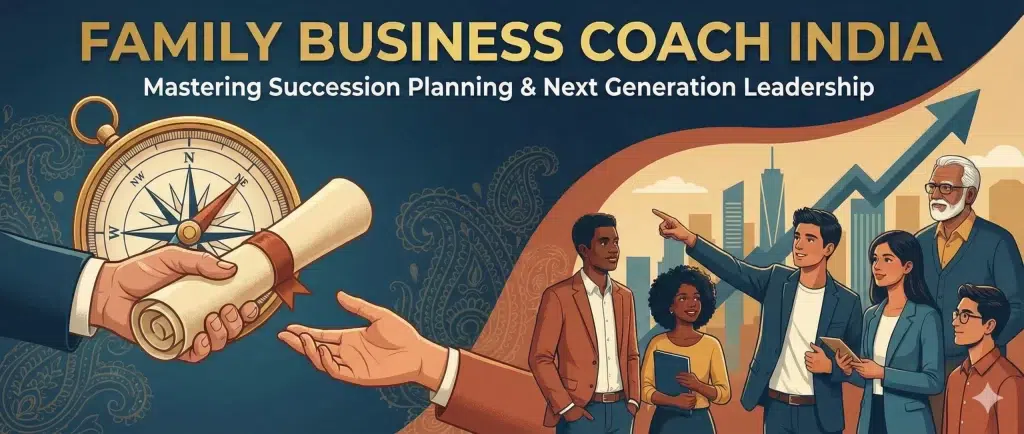
In India, family businesses form the backbone of the economy, contributing over 70% to the GDP and employing millions. Yet, statistics reveal a stark reality: only about 30% survive the second generation, and a mere 12% reach the third.
As a Family Business Coach India, Coach Dilip Pandya has witnessed firsthand how poor succession planning in family business derails legacies.
Coach Dilip Pandya enables C-suite leaders and next-gen entrepreneurs to bridge this gap, ensuring seamless transitions and thriving next-generation leadership.
This blog explores why succession planning is non-negotiable for Indian family enterprises, common pitfalls, proven strategies, and how professional coaching transforms challenges into opportunities.
Why Succession Planning Matters for Indian Family Businesses
Family businesses in India are legacies woven with emotion, tradition, and ambition. From textiles in Surat to gems in Jaipur, these ventures thrive on trust, generations of running the business tactfully, and shared values. However, without structured succession planning, conflicts erupt, talents are sidelined, and at last, the growth stalls.
Consider the Tata Group, a benchmark for family business succession. When J.R.D. Tata handed over to Ratan Tata in 1991; it wasn’t a mere title transfer. Years of grooming, board involvement, and merit-based selection ensured continuity. Today, under N. Chandrasekaran (a non-family professional), Tata’s market cap exceeds $400 billion, proving that deliberate planning sustains family businesses.
Contrast this with failures like the Singhania family feud at Raymond Ltd., where brotherly rivalries led to public battles, eroding shareholder value by billions.
As a Business Coach, Dilip Pandya emphasizes: Succession is not about picking an heir. It is purely about building a leadership pipeline resilient to disruptions.
Common Challenges in Next Generation Leadership
Transitioning to next generation leadership in family businesses often hits roadblocks unique to India’s cultural fabric—guru-shishya dynamics, filial piety, and “My son will handle it” complacency.
- Emotional Attachments: Founders cling to control, viewing successors as inexperienced. This delays handover, fostering resentment.
- Skill Gaps: The next generation raised with the background of global MBAs and startups clashes with traditional wisdom. A 2023 PwC India survey found 60% of family firms lack formal leadership development.
- Governance Void: Blurred lines between family council and boardroom invite favoritism.
- Wealth Dilution: With multiple heirs, equity splits fracture unity, as seen in the Godrej Group’s recent division into two public entities to avert disputes.
These issues amplify in sectors like MSMEs in Gujarat and Maharashtra, where 90% of businesses are family-run. Without intervention, next-generation leadership falters, leading to value erosion.
Coach Dilip Pandya’s 5-Step Succession Planning Framework
C-suite & Leadership Coach Dilip Pandya deploys a battle-tested framework for family businesses, blending global best practices with Indian ethos. Here’s how we guide clients:
- Assess Readiness: Start with a 360-degree audit. Evaluate the founder’s exit readiness, successors’ competencies, and family dynamics via confidential interviews.
- Define Vision & Roles: Co-create a family constitution outlining values, governance, and roles. For instance, we helped a Vadodara-based pharma firm clarify CEO vs. Chairman duties, averting a rift.
- Develop Next-Gen Leaders: Tailored coaching hones skills like strategic thinking and conflict resolution. Drawing from the Bajaj Group’s model—where Rahul Bajaj groomed Niraj and Madhur via rotational roles across auto and finance arms—we simulate board scenarios and executive shadowing.
- Build Governance Structures: Introduce family councils, independent boards, and ESOPs. The Aditya Birla Group’s succession to Kumar Mangalam Birla exemplifies rotating leadership with professional oversight.
- Monitor & Adapt: Annual reviews with KPIs ensure agility. We use tools like balanced scorecards to track cultural fit and financial health.
This framework has propelled clients like Ahmedabad’s textile giants from stagnation to 25% YoY growth post-transition.
Real Indian Success Stories in Succession Planning
India brims with succession planning triumphs that inspire. The Murugappa Group, a Chennai conglomerate, rotated leadership across 29 businesses over generations via a professional selection committee—mirroring corporate rigor while honoring family bonds.
In contrast, the Wadia Group’s saga at Bombay Dyeing highlights pitfalls: Nusli Wadia’s solo control sparked disputes with Tata, costing market share.
For MSMEs, take TVS Group. From motorcycles to logistics, TVS’s non-linear succession—empowering cousins like Venu Srinivasan—demonstrates meritocracy.
As a Business Coach, Dilip Pandya replicates this by fostering “leadership labs” where next-gen solves real problems.
The Role of a Dedicated Family Business Coach
With ICF-accredited coaching and decades of mentoring C-suite leaders in medical equipment, manufacturing B2B and B2C firms, and many MSMEs, Coach Dilip Pandya has delivered 30% to 300% growth and 100% of our clients.
Benefits include:
- Conflict Mediation: Neutral Facilitation Heals Divides.
- Skill Acceleration: Customized interventions and workshops
- Mindset Transformation: Enabling the shift in the mindset of teams across all levels
Future-Proof Your Legacy Today
Succession planning in family business and next-generation leadership demand action now. With India’s economy booming, delay risks irrelevance amid startups and MNCs.
Ready to turn the family business into a sustainable one? Book a 1:1 session with Coach Dilip Pandya for a free succession readiness assessment.
As a trusted Coach, Dilip Pandya brings proven guidance to help you move forward with clarity and purity in objectives, leading to fulfillment of the organization’s vision.